AI Chat App
AI · LLM · EMBEDDINGS · LEGAL TECH
Making an AI tool that lawyers actually use
Most people at law firms don't care about AI. They want to get to work, do their job, and go home. This project was about embedding intelligence into places where that's already happening.
COMPANY
Filevine
ROLE
Director of Product Design
SCOPE
Research, UX, UI, Strategy
IMPACT
65%+ faster doc review

The problem with "AI features"
Two of the best use cases for LLMs are analyzing documents and consuming large volumes of data. Law firms have both in excess. People at law firms want to get up to speed quickly and feel confident they're not missing something important to a case.
But after talking to hundreds of users about AI, I found that the vast majority just don't care. They're not opposed to it. They simply aren't incentivized to change how they work, even when a tool would make them more efficient.
The challenge
give users fast context on documents and case data without asking them to change their workflow.
Embedding AI where work already happens
Rather than building a standalone AI product and hoping people would adopt it, we took an incremental approach. Each step put intelligence closer to an existing behavior.
AI Fields
Inputs that auto-analyze uploaded documents by running a specified prompt against them. No new screen, no new workflow. Just smarter data capture on forms users already fill out.
AI Doc Review
A prompt action embedded in the context menu when users already take actions on documents. Intelligence at the point of decision.
Sidebar (AI Chat)
A full conversational AI built inside the existing peer-to-peer chat app. Users could query case data and documents in natural language, powered by proprietary embeddings.
Redesigning the chat experience
The existing Sidebar app already had the infrastructure for threaded conversation. But user testing surfaced three things that required a redesign:
Users want to start a new chat per topic. Quick, fresh starts matter more than history browsing.
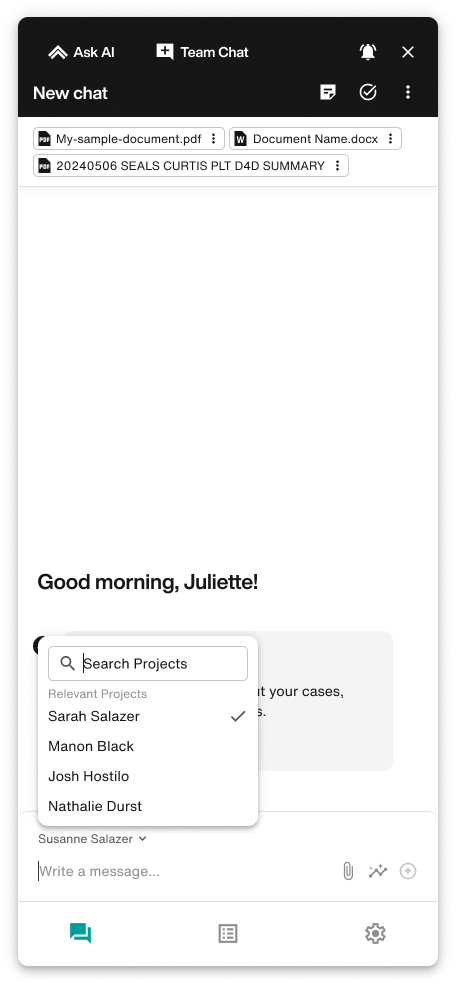
Users want to just start chatting without making a decision first. The old UI forced a choice before any interaction.
Users expect a "smart" tool to look modern. The existing UI signaled peer chat, not AI assistant.

Before: History-first, required a choice to start chatting

After: Chat-first, new conversation always one tap away
A mobile-style footer nav reduced navigation distance from the chat input. Updating the input styling from a text area to a more capable-feeling bar made the app feel expansive. Shifting the palette from greens and purples to monochrome made it feel more professional without losing personality.




65%+
Reduction in document review time vs. manual review
Near real-time
Case summaries and data capture that previously took hours
What came next: the AI workspace
With chat validated, the question became: what happens when AI stops being a sidebar and becomes the surface? We explored a personalized workspace where users collect documents, chat, and get proactive insights from widgets they didn't think to ask for.


What this project taught me
The AI chat bot occasionally surfaced correct information that had been entered incorrectly by humans. That detail reshaped how I think about AI product design. The goal isn't replacing human work. It's creating a feedback loop where the system catches what people miss, and people catch what the system gets wrong. That's the design problem worth solving.
NEXT PROJECT
Enterprise Payments Platform
Designing a 0→1 payment system that integrated across an ecosystem of legal tech products.
